



Knowledge
Applied Production and Effect Techniques
On all texts in the Knowledge area: I write here from my own work and perspective.
The essences of my Sound Journeys are the methods I work with. With Mind Music, I merge the knowledge of spiritual healing frequencies, cosmic rhythms, meditative chants, spatial soundscapes and psychoacoustic production techniques with intuitive and long-standing compositional experience.
What is contained in an individual piece is stated on its page under “Means used”. Here is what the individual methods are in the first place.
Sound in space
Recordings at special places
According to my recording documentation, some monks’ chants come from a temple in Dharamshala, India. Dharamshala is the town; higher up in McLeod Ganj are the residence of the Dalai Lama and the main temple grounds, Tsuglagkhang. Other sounds were recorded during spiritual events, prayers or meditations. I assume that the intention during the recording can also become perceptible when listening. I cannot prove this.
8D headphone surround
All pieces are produced for spatial playback through headphones. “8D” is not a technical standard with eight dimensions, but a common name for moving or spatially placed stereo sounds. Ordinary headphones are sufficient. Some listeners report that the spatial sound helps them immerse themselves and relax; this does not guarantee a particular state of consciousness.
Recordings at original locations
Some of the sounds are recordings from original locations. In Sounds of India and Floating Waters, they carry the entire piece. In others, they lie quietly in the background and can remain outside the current focus of attention. In my experience, they support inner letting go.
Frequencies that set a beat
Monaural tones
If two sine tones with slightly different frequencies reach the same ear, they overlap physically. Their volume rises and falls to the beat of the frequency difference. This pulse rate can be used in production as a modulation frequency. Whether it thereby triggers a particular mental state is a separate scientific question.
The brain can respond to regular rhythmic stimuli with measurable temporal responses. Depending on whether you are awake, dozing or asleep, EEG patterns differ statistically; however, no individual frequency band reliably switches on a particular state of consciousness.
Brainwave Entrainment is the term for the assumption or process that periodic stimulation binds neuronal activity to its beat. A measurable auditory steady-state response initially shows that parts of the auditory system respond temporally to a stimulus. By itself, it does not yet prove an altered state of consciousness.
Binaural tones
Both ears receive, as separately as possible, one tone each with a slightly different frequency. The binaural beat only arises in auditory processing; headphones are usually used for controlled separation of the ear signals. Individual studies found increased coherence between particular auditory cortices, while other findings argue against reliable entrainment. Synchronisation of the whole brain or reliable calming does not follow from this. It is explained in detail under When Both Hemispheres of the Brain Fall into the Same Beat.
Isochronic tones
With isochronic pulses, the volume of a carrier tone is switched strongly on and off at regular intervals. The pulse is already physically contained in the signal and can be played through headphones or loudspeakers. That a particular pulse rate produces a desired state is not thereby established.
The bands
Delta activity often occurs in deep sleep, theta among other things when dozing, alpha often in relaxed wakefulness and beta with active attention. The boundaries vary and several bands occur at the same time. In production, I direct pulses towards particular ranges; whether a desired state arises as a result is not guaranteed.
Tunings and pitches
432 Hz tuning
In many pieces, all instruments are tuned to 432 Hz instead of the usual standard today.
Solfeggio frequencies
A modern series of pitches to which meanings are assigned in this spiritual teaching. 528 Hz occurs in Healing Joy; 852 Hz is associated in A New Dawn with inner strength and spiritual connection. These meanings are not proven effects of the pitches.
Planetary tones
Orbital periods of celestial bodies are mathematically doubled until values in the audible range arise. A New Dawn uses a solar value from this Cosmic Octave, Typhon a value calculated from Saturn’s orbit. These are not measured natural frequencies of the celestial bodies.
Schumann resonance
The lowest electromagnetic resonance mode of the cavity between the conductive Earth’s surface and the ionosphere is typically close to 7.8 Hz. In Floating Waters, this number is used as a compositional reference; the natural Schumann resonance is not an audible tone.
Where these systems come from, what is substantiated about them and what is not, is explained in detail in Frequency Systems in Sound Work. I deliberately keep that separate there.
How a piece is built
Every piece has a planned course. It begins so that you can follow it well in waking daytime consciousness. In production, the beginning is oriented more strongly towards relaxed wakefulness and active attention; however, daytime consciousness cannot be equated with a single EEG band.
Over the course, the sounds usually become calmer, the intervals wider and the musical pulse slower. This is intended to accompany a gradual settling down. In many pieces, I shift the built-in pulse rates into numerical ranges called alpha or theta; in music for energy and concentration, I plan the course differently. This describes the production of the stimulus, not a measured EEG of the listeners.
In this way I would like to encourage a calm and inwardly connected listening experience. Whether coherence between the cerebral hemispheres actually changes in my pieces was not measured. The research so far on binaural beats does not demonstrate synchronisation of the entire brain. More on this is under When Both Hemispheres of the Brain Fall into the Same Beat.
I build the course on the assumption that fine rhythms and sounds are more easily perceived in a calmer, attentive state. That these elements work exclusively then or precisely then most strongly has not been scientifically demonstrated.
In this state, something else becomes possible that no longer has anything to do with production technique: the connection with the field of the piece. This is what The Field of a Sound Journey is about.
How I compose
First I rely on my gut feeling and write sounds, harmonies and structures that I consider right for the desired effect. Then I adjust the course. It is not only about which sounds come at the right time, but about writing the song so that the music serves as guidance.
The music should stand in the foreground only at selected points; otherwise, it should serve as accompaniment for your own inner journey. The course, volumes and production techniques meet you at one point, take you along, and at the end the piece gently releases you back into reality.
Non-linear song structure
Many pieces do without conspicuous loops and repeated musical rhythms. This is a compositional decision: the course is intended to make you attentive without pushing itself into the foreground. Additional strong rhythms can alter or mask the modulation actually present in the signal. But it has not been established that entrainment pulses must fundamentally work alone or that every superimposed rhythm cancels their mental effect.
All pieces consist of their own arrangements and compositional structures. The length of 15 to 60 minutes gives me room for a slow musical course. How quickly relaxation, tiredness or concentration change is individual. It has not been established that shorter pieces fundamentally cannot accompany such a state.
Three construction methods that keep recurring
Progressive construction: a piece becomes quieter and calmer over its length; Sleep Waves is built this way. Reduced arrangement: few sounds form a homogeneous carpet of sound without dominant individual tones. This can tone down the musical foreground; Samadhi works this way. Coordination of parameters: timbres, tempi and effects are coordinated with one another so that a coherent overall impression arises. A high psychological degree of effectiveness does not automatically follow from this.
Psychoacoustic production techniques
By this I mean methods that work with spatial perception, volume, masking and temporal sound design. I use them with the aim of not stimulating the stream of thoughts additionally. Whether they actually calm it without consciously standing out as a separate sound was not measured in my pieces.
Bio-composition techniques
“Bio-composition” is my own term here for compositional decisions that are oriented towards described rhythms of the body and nature. It is not an established scientific technical term and does not replace evidence of effect.
Where the sounds come from
Traditional sounds
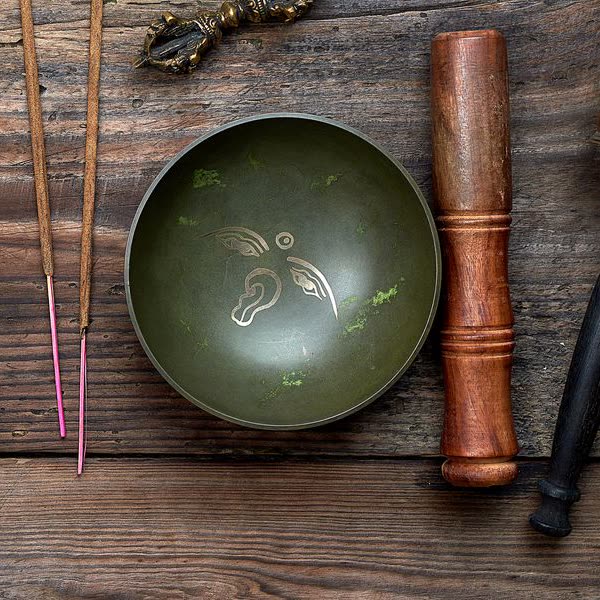
Sounds and chants belong in many cultures and religions to ritual, prayer and communal practice. A so-called medicine drum or shaman drum, Indian mantras, Gregorian chants and singing bowls used in meditation today come from different contexts and must not be mixed into one uniform healing method. I take up individual sounds musically; their spiritual meaning and a medical effect are separate questions.
Natural tones and further instruments
Natural-tone instruments such as the natural horn or alphorn produce different tones from the same fixed air column without changing its length through valves or finger holes. The pitches approximately follow the harmonic series and can indeed form melodies. Drums belong to percussion, flutes usually alter their tube length through finger holes, and the didgeridoo has its own Aboriginal culture and playing tradition. These instruments therefore do not in general belong to the same category.
Animal and nature sounds
The sound of waves, the chirping of crickets and wind can form a soundscape. From developed hearing ability onwards, a foetus in the womb perceives, among other things, maternal body sounds, voice and muted external sounds. It does not follow from this that nature sounds automatically calm every person later. I use them because many listeners experience them as familiar or relaxing and because they musically suit the respective place.
Processing
Nature sounds can be shifted in pitch or stretched in time. This changes timbre, duration and rhythm; a particular psychological effect does not automatically follow from this. I sometimes mix them so quietly into the composition that they can remain outside the current focus of attention.
How effective frequencies enter the music
A binaural signal can technically consist of two sine tones, an isochronic one of one distinctly pulsed tone. Such bare signals can sound monotonous or unpleasant to some people. I therefore mix them into musical sounds for aesthetic reasons; technically, this mixture is not necessary.
I therefore usually do not place such pulses underneath as a conspicuous extra track. Instead, I integrate them into the composition through synthesiser programming, tempi, effects units, phase shifts and triggering individual tracks. A phase shift is initially an audible or inaudible production parameter; by itself it does not demonstrate a physical or mental effect.
Strong additional rhythms can overlap with the intended pulse and alter the resulting modulation pattern. I therefore avoid them if the planned pulse is to remain distinct. Whether a desired mental effect actually fails to occur as a result cannot be claimed without measurement.
What I cannot measure
Information fields
Alongside the morphic field, I work with what I call information fields. By this I mean the information and qualities that I connect with a piece while composing and in a concluding meditation. This is experiential knowledge from my work as a healer, not a physical finding, and I do not present it here as one.
Part of my work cannot be checked with a measuring instrument. I write it down anyway because it belongs to the truth about these pieces.
Through intuition and through what I experience as mediumistic communication, I receive inspirations for frequencies and parameters of a song. I also partly use the Bio-Tensor for this. I coordinate melody, individual tones, tempo and frequencies with the vibration and intention with which the piece arises. This describes my personal way of working and is not an objective measurement of a later effect.
At the end, I connect the entire music in a meditation with symbols, numbers and information from cards and crystals with the help of my spiritual helpers. With Avalon, this includes crystal information and an energetic charging through the morphic field assumed by me.
This way of working is explained in detail under Composing with the Spirit World.
How I classify this
This is experiential knowledge from my work, not a measurement result. It has a different status from a series of measurements, and it should not pretend to have the same one. Whoever cannot make anything of it loses nothing: The pieces work as music even then.
Why you should hear as little of it as possible
Compared with productions using effective frequencies by other artists, composition and aesthetic sensibility are in the foreground for me. Where possible, I integrate all these techniques so far into the composition that you do not consciously notice them or find them disturbing.
A technique that pushes itself into the foreground draws your attention to itself. But you need exactly that elsewhere.