


Knowledge
When Both Hemispheres of the Brain Fall into the Same Beat
On all texts in the Knowledge area: I write here from my own work and perspective.
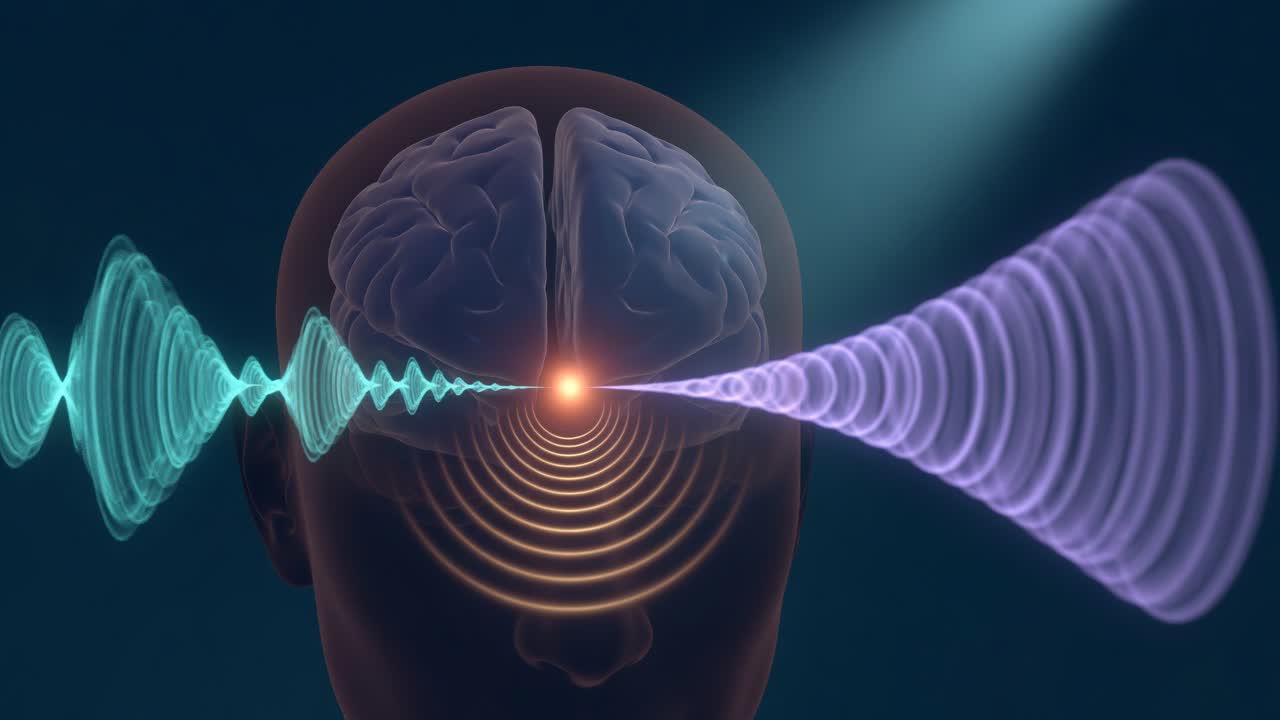
With binaural tones, people often speak of a synchronisation of the hemispheres of the brain. The expression sounds more comprehensive than research supports. That is why this explains exactly what was measured and what remains an interpretation.
Two halves, one corpus callosum
Your cerebrum has two halves, the hemispheres. They are connected by the corpus callosum, a thick bridge of nerves in the middle. The two sides are not occupied in the same way: for most people, some tasks take place more on the left, others more on the right. Language, for example, is more strongly represented on the left in the majority.
Depending on the task, patterns of activity and specialisations of the two sides can differ. Nevertheless, the hemispheres work together constantly; there are neither two independent brains nor a single overall rhythm in which each half runs completely.
What is wrong with the “left and right brain”
From the sidedness of individual tasks, in specialist language lateralisation, came the popular story of the left-brained rational person and the right-brained emotional person. A study from Utah evaluated resting recordings from 1,011 people in 2013 and examined the functional laterality of connections between 7,266 small regions. Individual connections and nodes were clearly lateralised. But the data did not yield a consistent whole-brain pattern according to which a person would be left- or right-dominant overall. Lateralisation concerns particular functions and locations; it is not a personality type.
Where the term comes from
Hemi-Sync® is a brand name from the circle around Robert Monroe and stands for hemispheric synchronization. According to the Monroe Institute's own history, the beginnings of research into sound go back to the late 1950s; the institute was founded in 1971. Monroe's first relevant US patent was filed in 1970 and granted in 1975. It described a sound modulated with EEG sleep patterns, not yet the later patented binaural procedure. Patents involving binaural beats followed in the 1990s. A patent documents a claimed technical invention, not its effectiveness.
Why this suggests itself with binaural tones
With a binaural beat, each ear receives its own tone. If 530 Hz is played on the left and 520 Hz on the right, neither ear signal contains a physical loudness pulsation of 10 Hz. The pulsation only arises as a perception in the central processing of both signals.
The superior olivary complex in the brainstem is the first central auditory station to receive information from both ears. The medial superior olive in particular processes tiny time differences that are also important for sound localisation, and is considered a likely important structure in beat processing. However, the perceived beat cannot conclusively be assigned to a single nucleus as its unambiguous site of origin.
The beat demonstrates binaural processing. Whether this produces a more extensive alignment of the two cerebral hemispheres is another and clearly more open question.
What has been measured
There is real research on this, and it is mixed. I write here what I found, including what does not suit me.
What supports it
Solcà, Mottaz and Guggisberg examined a narrowly limited finding in 2016. During binaural beats, alpha coherence between two areas of the auditory cortices determined computationally from EEG signals was higher than during monaural beats and at rest. Both a 10 Hz beat and a 4 Hz beat increased coherence in the alpha band.
What argues against it
Immediately afterwards, a dichotic digits test – in which both ears hear different digits simultaneously – showed no behavioural effect. Because the 4 Hz beat also increased alpha coherence and not corresponding theta coherence, the authors interpreted the finding as binaural integration and not as entrainment to the beat frequency.
What cuts across it
Orozco Perez, Dumas and Lehmann investigated binaural beats in 2020, according to their own statement for the first time below the cerebral cortex (subcortically), with EEG. Binaural and monaural stimuli both produced an electrical response that followed the audible carrier frequencies (Frequency-Following Response); there was no difference between the types of beat there. The carrier frequencies are the two tones actually heard, not their difference. At the beat frequency, the cerebral cortex responded to both stimuli, but more strongly to monaural beats. The authors found no change in mood.
The systematic review by Ingendoh and colleagues (PLOS ONE, 2023) found fourteen suitable EEG studies: five reported findings in line with the entrainment hypothesis, eight contradicted it and one produced a mixed picture. Because of greatly differing stimuli, experimental setups and EEG analyses, the studies were only comparable to a limited extent; the review calls the evidence at best inconclusive.
A finding from the other side
In individual meditation studies, altered coherence patterns between recording sites were observed. Results, however, differ according to method, tradition, experience and frequency band. This is not a uniform “meditation value” and not evidence that music produces the same effect. For my work, the experienced connection between calm attention and music remains important; I distinguish this experience from the EEG finding.
What I make of this
The early integration of both ear signals in the brainstem is anatomy. During stimulation, Solcà and colleagues measured increased alpha coherence between particular areas of the two auditory cortices, computationally localised from EEG signals. From this follows neither that the whole brain runs in synchrony nor that a person is reliably changed by it.
In their feedback, many listeners describe a calm yet alert state and less of a juxtaposition of thinking and feeling. These reports document personal experiences. They do not show whether the music alone was their cause or whether “synchronisation” is the right neuroscientific term for it.
In my spiritual understanding, a calm, attentive state can also facilitate connection with the field of a piece. This is my experience and not a conclusion from an EEG finding. More on this can be found under The Field of a Sound Journey.