


Knowledge
Optimal Application
On all texts in the Knowledge area: I write here from my own work and perspective.
A Sound Journey requires little from you. But a few things make a noticeable difference.
Headphones
You should listen to most pieces with headphones, because that is what they are produced for. Their full spatial effect and the controlled separation of binaural signals arise there most reliably. With speakers, both channels usually reach both ears.
Isochronic elements are already contained in the signal as a physical pulse and can therefore also be played through good speakers. Which pieces contain such elements is stated on the respective Sound Journey page.
Time and place
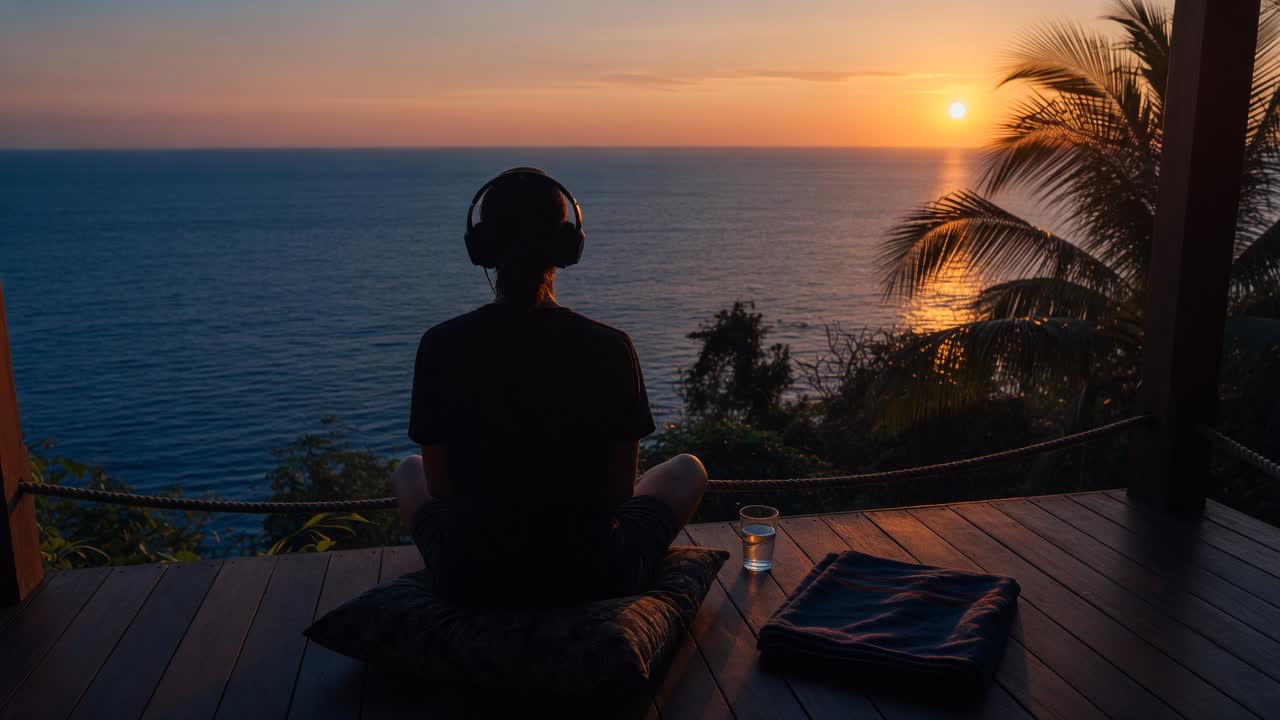
Lie down or sit in a way that lets you really relax your body. An upright seated posture is enough too, as is leaning back. If you like, take a meditative posture, the half or full lotus position.
The volume depends on the purpose
Choose a volume that is comfortable for you. You should be able to recognise all sounds clearly; no sound should be unpleasant. Keep all sound controls neutral, with no bass or treble boost.
Invigorating
It may be a little louder, as long as it does not become unpleasant.
Relaxing
More moderate. You should hear all tones well, but it is completely fine if you have to listen a little more closely for the quiet passages.
Sleep-inducing
Quiet enough that you still hear everything, but need to concentrate if you want to follow the song. Not so quiet that the soft tones disappear.
Try things out a little and find the setting that suits you. Do not change it after that.
Which headphones
Conventional stereo headphones of reasonably good quality are enough. In-ear headphones are well suited to the spatial recordings because they separate the 3D sounds cleanly.
Before you start
- Find a comfortable sitting or lying position.
- Take the time the piece lasts, and make sure that you will not be disturbed.
- Drink a glass of plain water before and after the session.
- Set the volume with the first sound so that you hear all sounds clearly. Do not change it after that.
Let the mind step aside
Allow your analytical mind to step aside a little while listening. Simply follow the sounds, but do not think too much about what is happening or about the music.
An open attention or attention directed towards the exercise can help you perceive subtle sounds and your own reactions. It is not a necessary prerequisite for an objectively established effect.
An exercise you can always do
If you do not know what to pay attention to: Pay attention to where the sounds appear around you in space. Above, behind, right, left. If thoughts or feelings arise, observe them briefly and then lead your focus back to the music.
That sounds simple. It is the most reliable way to occupy the mind without letting it analyse.
Repetition
Repeated listening makes a piece more familiar and can change the experience. A piece that barely touches you the first time can have a different effect later – but it does not have to. If a Sound Journey appeals to you, you can stay with it for a while.
Go in with a question
With the meditative pieces, you can go into meditation with a question. Afterwards, observe openly whether thoughts, feelings or possible answers arise. This can also happen later, but does not have to; the music does not convey a reliably correct answer.
If you keep falling asleep
Tiredness is to be expected with some calm pieces, and you can doze or fall asleep while listening. Without sleep measurement, it cannot be determined with certainty which sleep or transition phase you are in.
Vivid images or the feeling of dreaming and at the same time still noticing something can occur in the falling-asleep phase. This transition is called hypnagogia or half-sleep. It does not prove any special “dream sleep”, and practice does not guarantee that you will reach it more quickly.

If you do not want to fall asleep
- Preferably choose a sitting or leaning position if you want to stay awake.
- Bring your attention back again and again to a sound or to the breath; this can support wakefulness, but does not reliably prevent falling asleep.
- If you feel tired after the ending, give yourself time to orient yourself. Only get up once you feel sufficiently awake and safe again.
If you want to fall asleep
- Keep your concentration up at the beginning.
- If you notice that you want to drift off, give in to your dreams.
Why it is not the same every time
The experience changes depending on how you are that day. Whether you are tired or have had coffee makes a difference. Sometimes you doze off, sometimes you stay awake. Sounds can also be processed while dozing; but this does not mean there is any guaranteed, precise effect of the music.
Mind Music is mixed in such a way that not every detail has to be in the focus of attention. You still hear the music; “unconscious” here does not mean that hidden content is reliably transmitted.
The more you contribute, the more happens
You can simply relax and listen, or use the music as a framework for breathing exercises, self-perception, meditation or mental techniques. An active exercise changes your focus of attention; whether this makes the experience stronger is individual.