


Knowledge
The World Is Sound
On all texts in the Knowledge area: I write here from my own work and perspective.
In my spiritual worldview, the “music of life and of the universe” stands for experience, growth, exchange and personal healing. This is a symbol and not proof that vibrations heal medically.
Rhythm is a temporal order of processes, vibration a repeated change around a state of equilibrium. Sound is therefore a powerful image of life for me, but scientifically not the basis of all being.
What vibrations are
In my spiritual language, “vibration” stands for connection and change. Physically, the term is narrower: sound is a mechanical wave, light is electromagnetic radiation, and not everything perceptible is the same kind of vibration. The image helps me when composing, but it is not a complete scientific description of the world.
Our senses react to different stimuli: the ear to fluctuations in pressure, the eye to light and the nose to molecules. The brain processes these into tones, colours and smells. Feelings and thoughts are not frequencies received with a radio; they arise from complex activity in the nervous system and are described here only figuratively as “vibration”.
Because we could not process everything at the same time, the senses and concentration filter out what is important at the moment. Like a television that shows only the one channel from the air that you want to watch, although the signals of all the others are there as well.
What physics says about it
String theory is a mathematical model in which the fundamental objects are tiny one-dimensional strings rather than point-like particles. Different quantised vibrational states are supposed to appear as different particles. These “vibrations” are not audible tones. Modern physics explains why matter appears solid and impenetrable through electromagnetic interactions, quantum mechanics and the Pauli exclusion principle – not because bodies vibrate at similar frequencies.
Important here: String theory is a physical model and has not yet been experimentally confirmed. It is a beautiful image for what I think when composing. It is not proof of this.
What sound is
Sound is nothing other than vibration that our ears can perceive. It is transmitted through the air and makes our eardrum vibrate through changes in air pressure. The brain turns that into what we believe we hear.
Noise
An audible sound signal that, in a musical or everyday context, is not classified as a particular tone or desired sound. Acoustically, a noise can be regular or irregular and contain many frequency components; it does not necessarily arise by chance and is not fundamentally inharmonious.
Tone
In the physical ideal case, a sine vibration with one frequency; musically, “tone” is also used more broadly. Whether something sounds pleasant depends not only on frequency, but among other things on volume, duration, timbre, context and the person.
Sound
A sound event with a spectrum of several frequency components and a progression over time. Many musical instruments have a fundamental and overtones; these are often approximately at whole-number multiples, but can also be inharmonious. Noise components can also be part of it. Example: attack, spectrum and decay help to distinguish a piano tone from a flute tone.
Resonance
 AI-generated
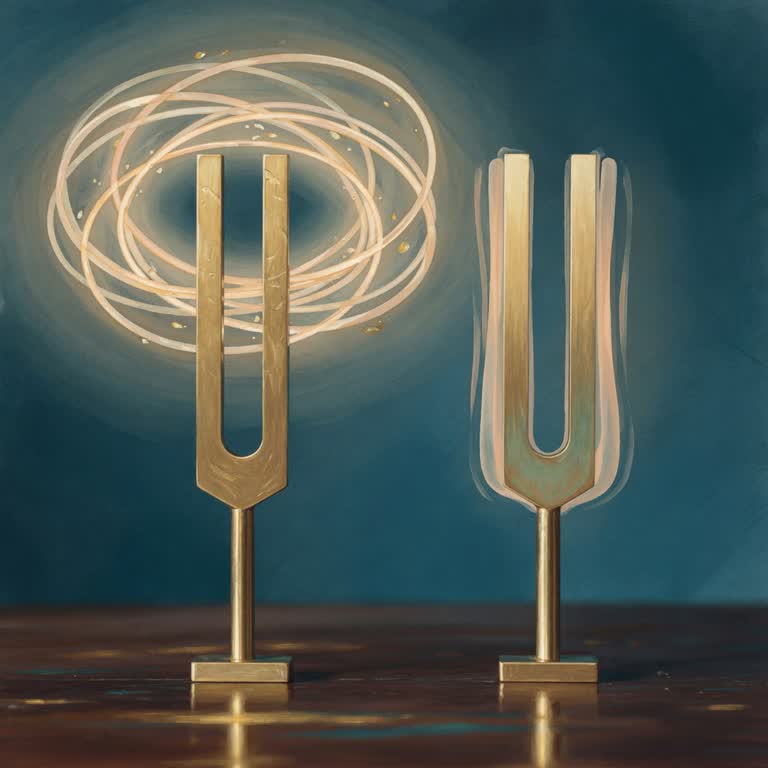
A system capable of vibration usually has several natural modes rather than only one natural frequency. If it is suitably excited close to one such mode, the response can become greater through resonance. Example: if you hold two tuning forks tuned alike next to each other and strike one, the other can audibly vibrate along.
Musical instruments use such couplings deliberately: a guitar string excites the soundboard and the air in the body, making the tone louder and shaping its sound. When speaking, vibrations are also transmitted to tissue and bone. However, the human body is a complex, damped system with many tissues and modes, not a uniform resonator with one body frequency.
How far that goes
Ultrasonic cleaning, medical ultrasound, Chladni figures and a glass of water next to a loud speaker each show concrete effects of mechanical waves under specific frequencies, intensities, couplings and materials. They do not demonstrate that quiet audible music correspondingly shapes or heals the human body. Laser light is electromagnetic radiation and not sound; its medical use follows other mechanisms.
Mantras
 AI-generated
Mantras are sacred syllables, words or sentences that are recited or sung in several Indian religions. Depending on the tradition, sound, meaning, breath, remembrance and religious practice can be important. The claim that a mantra has a fixed direct effect on the body independently of its meaning, or is fundamentally older than its meaning, cannot generally be demonstrated historically.
With drawn-out speaking, audible and tangible vibrations arise in the mouth, throat and chest area. Which place stands out particularly depends on articulation, voice and attention. Spiritual traditions can associate such sensations with chakras; no anatomical position or healing effect of the vowels follows from this.
OM, AUM and Nataraja
OM or AUM is a sacred syllable in several Indian religions and is spoken as a mantra or invocation. A-U-M makes phonetic components visible; interpretations differ between traditions. Nataraja shows Shiva as a cosmic dancer: drum, fire and gestures stand, among other things, for creation, dissolution, protection and liberation. A historical teaching that Nataraja created OM is not thereby established. Similarities to “Amen” and the connection with a musical fundamental are spiritual comparisons, not an equation in linguistic history.
The universe strives for harmony
Many processes follow cycles and rhythms, such as day and night, breathing or phases of sleep. The body coordinates some internal rhythms with the environment through zeitgebers such as light. However, neither a uniform rhythm of the world nor health and well-being automatically follow from this.
That the universe strives for harmony and balance is my spiritual image. It invites us to see our own life as part of larger connections, but it is not a law of physics.
Calm and a feeling of connection can be experienced as beneficial. Medical self healing or recovery cannot be promised from this, and treatment is not replaced by it.
Where these rhythms occur everywhere, outside in nature and inside in the body, is described under Rhythm and Frequency in Nature, Body and Life.
Why letting go is the key
The Sound Journeys are designed so that they can accompany relaxation or a meditative exercise. In my spiritual understanding, a calm state can make contact with the true self or higher guidance easier. A particular state of consciousness, an activation of self-healing powers or spiritual contact are not guaranteed by this.
In my spiritual understanding, when letting go, inner images, feelings or thoughts can arise which I interpret as helpful guidance. This is no guarantee that exactly the information we need will arrive in sleep; some things can also be understood as memory, intuition or unconscious processing.
The field of a piece
In my spiritual work, I assume that every piece develops its own morphic field. I experience this field as being shaped by me, by the spirit world and also by listening. With every further listening, a piece seems to me to become more accessible. This is my experience and not a scientifically proven property of music.
What exactly I mean by field, where the term comes from and what happens to it when listening is described under The Field of a Sound Journey.